Why solar + storage?
Generating power from the sun--a free and limitless source of energy--means more reliable and affordable electricity for Arizonans.
As the lowest-cost form of new power in the United States, utility-scale solar farms help drive down the cost of energy for everyone. Solar is also one of the fastest kinds of energy to deploy, playing a critical role in meeting Arizona's rapidly growing energy needs with home-grown electricity.
Paired energy storage absorbs excess solar generation to deploy onto the grid when it’s needed most, reducing strain on the grid during peak hours. This creates grid resiliency, stabilizes power supply costs, and enhances renewable availability.
Frequently asked questions
Chimney Canyon Energy Center is taking steps to be anaccountable neighbor, helping preserve Navajo County’s unique culture and landscape through responsible stewardship of the land and tangible community investment. We are directly responding to what we’ve heard from the community to build a project that minimizes impacts and is prepared for every scenario.
Chimney Canyon Energy Center Overview
Clearway is the developer and future owner/operator behind the Chimney Canyon Energy Center in Navajo County.We are one of the top five largest renewable energy companies in the United States, with more than 450 operating facilities across 27 states. As a developer and owner/operator, we are driving long-term investment in the communities where we work and live, producing domestic, reliable, andaffordable power. For more information, visit clearwayenergygroup.com.
Chimney Canyon Energy Center will capture Navajo County's abundant sunshine to generate locally produced, low-cost electricity with photovoltaic solar arrays. An on-site substation will connect the solar electricity into the regional grid to serve Arizona homes and businesses.
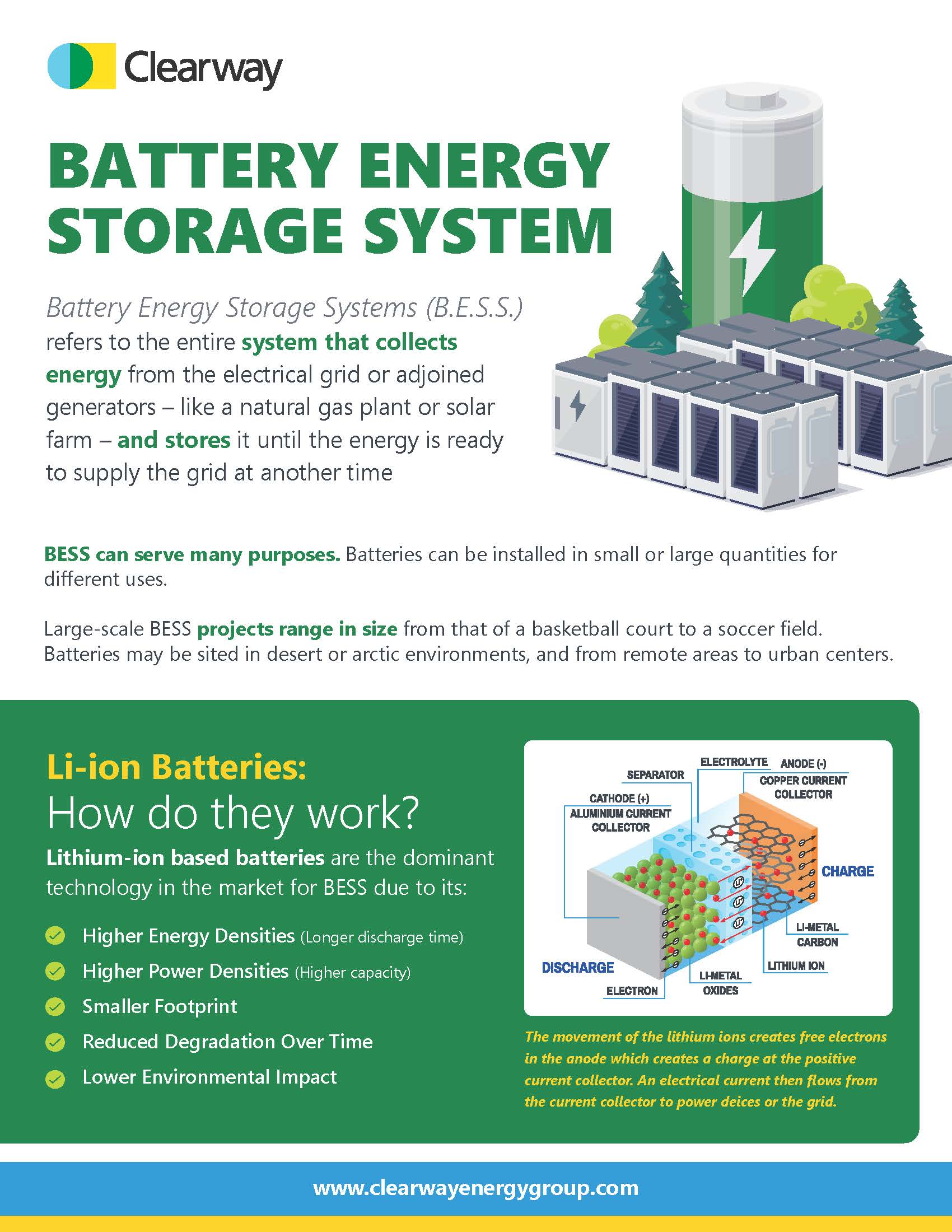
Chimney Canyon will also include a paired energy storage system. The batteries store excess electricity from the solar array during times of high production and low demand, then release it back onto the grid during high-demand hours to support reliability and help stabilize costs.
The facility will include an Operations & Maintenance building for full-time staff overseeing the equipment day-to-day.
Our plans are split into two phases:
- Phase 1: 600 MW solar + 375 MW storage (construction 2027-2029)
- Phase 2: 375 MW solar + 375 MW storage (construction 2028-2030)
Chimney Canyon Energy Center has an executed power contract with an Arizona utility, to be announced in coming weeks or months. The electricity will flow into the regional grid through an on-site substation, to serve the utility’s customers across the state.
American solar manufacturing has grown exponentially in recent years, with domestic facilities now capable of providing enough to meet most of the country's solar demand. Clearway has sourced solar panels made in Texas for the Chimney Canyon Energy Center.
Chimney Canyon Energy Center is 100% privately financed by Clearway. We work with major banks and financial institutions to raise the private capital needed to build.
Land, environment & natural resources
Chimney Canyon Energy Center will be located on privately leased land in Navajo County, Arizona, about five miles south of Joseph City, and 4+ miles from any non-participating residences. The land was formerly zoned for agriculture and low-density residential use.
Clearway has worked with third-party environmental specialists to complete numerous environmental studies as par tof our due diligence. These have included:
- Phase 1 Environmental Site Assessment
- Biological resources, including rare plants
- Aquaticresources
- Cultural resources
- Visual simulations
- Coordination with Arizona Game and Fish Department
We pledge to treat the environment with respect, not only for the private landowners we lease from but for the neighbors who love the Navajo County landscape and wildlife.
Chimney Canyon Energy Center's design follows direct guidance from the Arizona Game & Fish Department and Navajo County to allow area wildlife to pass through the area and minimize habitat impacts.
Habitat avoidance:
- Thorough multi-year habitat survey found no evidence of threatened or endangered listed species on project land.
- Sited to avoid floodplains and ephemeral washes, exceeding federal requirements for protection of aquatic resources.
- Transmission line sited along existing corridors to extent possible to minimize habitat fragmentation impacts.
- Solar area split into multiple smaller arrays to avoid environmentally sensitive areas.
Large game migration:
- Large migration corridor running through full project to accommodate large game like pronghorn and elk along existing natural migration routes (i.e. ephemeral drainages). The corridor's width ranges from 1,300 to 3,000 feet across, exceeding per Arizona Game & Fish Department's direct recommendations for a 1,300-foot-corridor.
- Additional smaller corridors may also be included which would provide more options for wildlife moving through the site and reduce bottlenecks.
- Unfenced areas between solar arrays arranged to avoid "dead ends," with rounded corners on fenced-in areas where needed to guide wildlife through and prevent entrapment.
Birds and small animals:
- 6-to-8-inch gap below fencing to allow small wildlife to enter and pass through the site unimpeded.
- A qualified biologist will conduct pre-construction wildlife surveys and provide environmental compliance monitoring during construction activities. This will include pre-construction nesting surveys (in accordance with Migratory Bird Treaty Act), which will set buffers around any active nests and avoid disturbance until young have fledged.
- Any lighting will be shielded and point downwards to reduce impacts to nocturnal species and preserve dark skies. Motion-sensor activation help keep the lights off except when needed by workers.
- Transmission lines are Avian Power Line Interaction Committee compliant to ensure safety for birds.
Protecting water should be a priority for everyone in Arizona, including energy producers. The county's ordinance requires developers to submit a preliminary water resource study identifying all water sources/watercourses and impacts.
The Chimney Canyon Energy Center will access water from an existing well on-site, in compliance with ADWR permits and state law. We are estimating our water use to be:
- ~0.2 acre-feet per acre during construction, used for dust control -- or ~1,600 acre. This is roughly eight times less than single-family residential water use.
- Operational water use will be near zero. A typical Arizona solar farm uses roughly 0.001-0.03 acre-feet per acre for annual panel washing, about 80 times less than residential use. The Chimney Canyon site should not require panel washing most years.
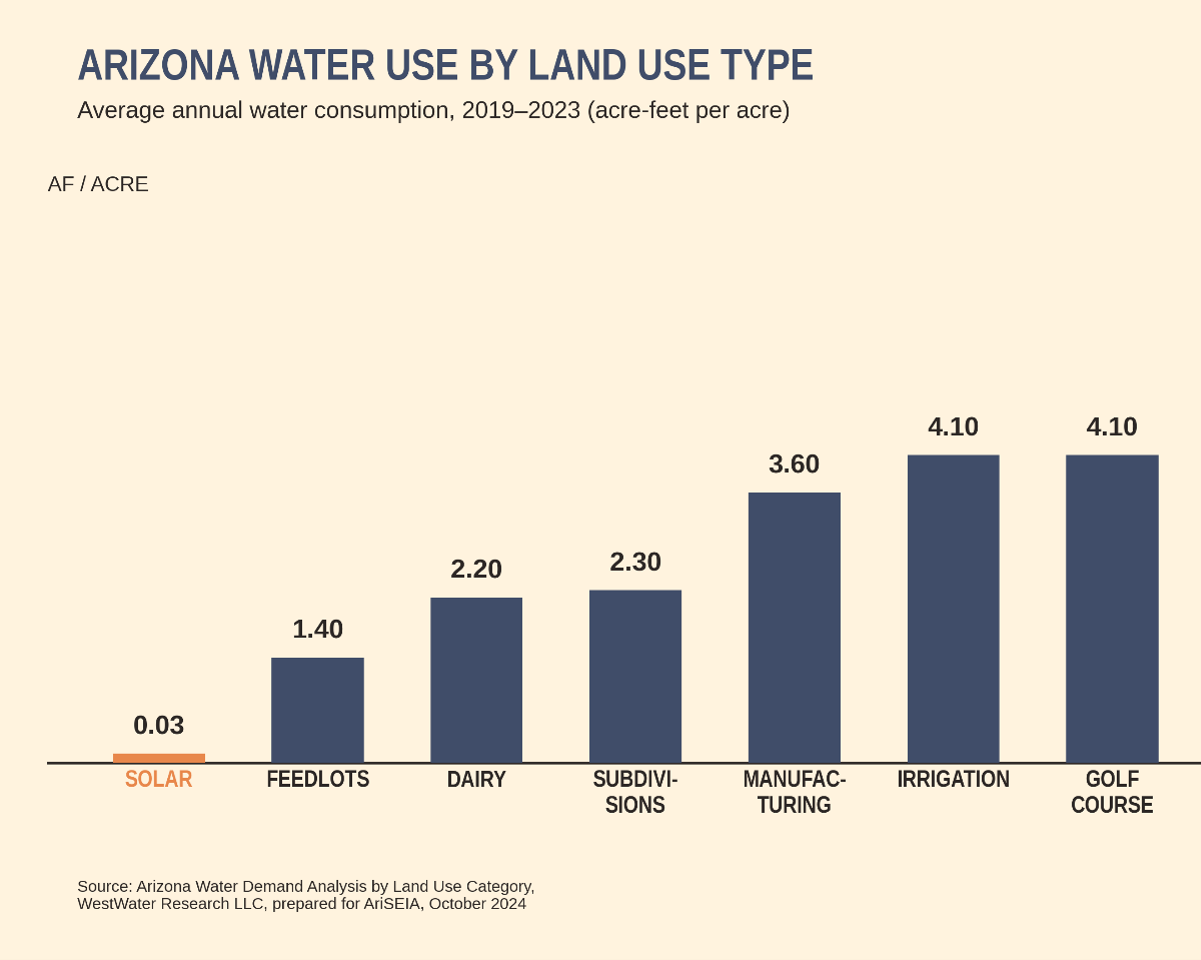
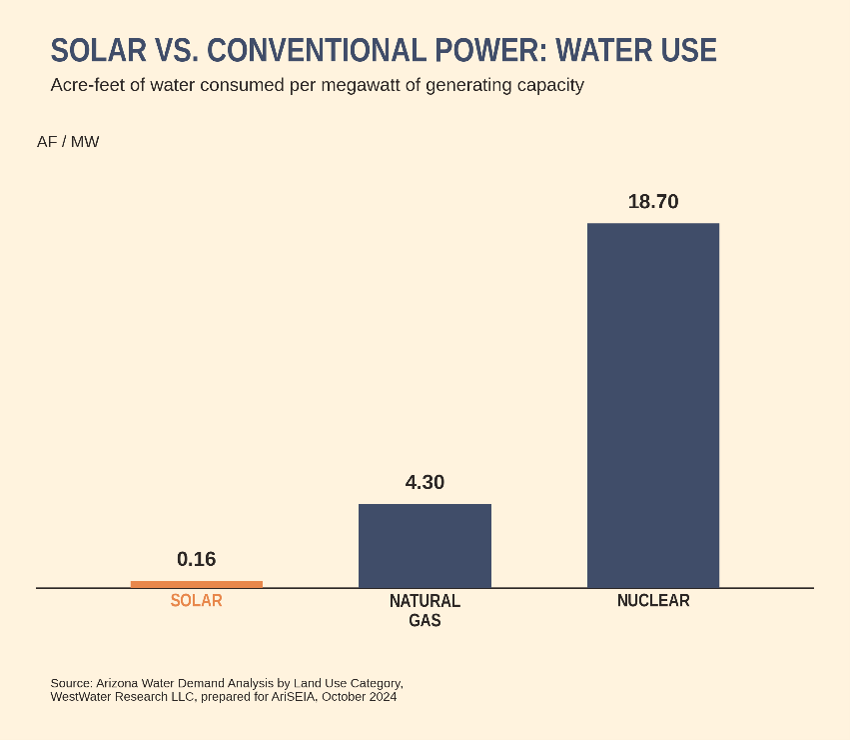
Photovoltaic solar is among the least water-intensive ways to generate electricity — using thousands of times less water than a traditional power plant.
When a solar farm is treated like a living landscape, soil stays healthier, preventing stormwater management and dust control issues.
We are required to implement a Stormwater Pollution Prevention Plan and best soil management practices in compliance with the Arizona Department of Environmental Quality. This includes revegetating at least 70% of the site, using native plants where possible, to stabilize soil, hold onto moisture and foster biodiversity.
We are also required to submit and implement a Noxious Weed Management Plan per our County Development Agreement, continuing through operations.
In addition, we have asked our construction contractor to hold onto topsoil during construction for later redistribution, which preserves the seed bank and allows for faster return to existing conditions.
What to expect
Clearway is committed to being a positive investment in Navajo County — offsetting any strain on public resources and paying our fair share. Our development agreement with Navajo County will allocate an up-front payment to help fund any county services and infrastructure affected by the project.
Clearway has also executed a Fire Service Agreement with the Joseph City Fire Department, which includes $10,000 yearly funding for local fire response capabilities, along with annual training and direct input on our site layout so responders have the access roads and response routes they need.
Any cleanup needed on county roads after construction is also Clearway's responsibility. A Road Use Agreement with Navajo County will also hold us accountable for funding any needed repairs.
In addition, we are pledging to allocate $1 million to local community benefit projects before Chimney Canyon Energy Center enters operations.
Under our preliminary designs, the Chimney Canyon Energy Center solar and storage equipment will be sited more than 5 miles away from any non-participating residences. As such, we do not expect to see any property value impacts.
View the resource below to learn more about research on solar and property values.
→ Solar and property values whitepaper
Solar panels themselves produce no noise. The storage containers and the inverters and transformers used to collect the electricity have a low hum similar to a home HVAC unit, typically audible only close to the equipment and not beyond the project boundary.
A study from the University of Maryland, looking at solar sites in Arizona, found that any minor temperature increases from solar panels dissipate within 100 feet and are much lower than ambient temperature increases created by urban areas. Because this effect is so limited, it does not have an impact on wildlife or people.
Safety & emergency preparedness
While we don’t expect and fire or safety incidents at Chimney Canyon Energy Center, it is our responsibility to ensure our local first responders are prepared for any scenario.
Per Navajo County's ordinance, we are coordinating with local fire departments to ensure they're aligned with our plans and prepared for any scenario. Our executed Fire Service Agreement with the Joseph City Fire Department includes $10,000 per year in funding, plus annual training covering site layout, access points, and technology-specific hazards.
We will also submit a Fire Safety Plan and Emergency Management Plan to the county, which will become enforceable under our negotiated Development Agreement.
Safety is Clearway's top priority at every energy facility we develop and operate.
Like all electrical infrastructure, battery energy storage systems are highly regulated to keep people and the environment safe. While fires have occurred on energy storage systems in the past, they are increasingly rare — a 2024 Electric Power Research Institute (EPRI) analysis found the fire-incident rate has dropped more than 97% in recent years due to technological advancements and stricter codes and standards.
Clearway builds multiple layers of protection into every facility to prevent fires:
- Strict adherence to codes and standards including NFPA 855 — the national fire code for energy storage,developed by fire protection engineers and enforced by state and local fireofficials — and UL 9540A, which independently tests batteries for fire safety
- Individually engineered battery enclosures with integrated monitoring, detection, and control features, so a fire in one battery won't spread to others
- Using the latest "Lithium Iron Phosphate" batteries capable of withstanding higher temperatures than other battery technologies
- 24/7 monitoring by on-site staff and our virtual control center, with features that shut batteries off if they get too hot or cold and alert operators immediately.
Clearway takes vegetation and equipment fire risk seriously at every site we operate. Chimney Canyon Energy Center will be managed under Clearway's O&M "Safety Fire Prevention and Protection" standard, which applies to every Clearway-owned and -operated facility and aligns with OSHA's fire prevention plan requirements (29 CFR 1910.39). Site staff conduct regular vegetation management and housekeeping to limit fuel buildup and combustible debris around the arrays, inverters, and substation; require a Hot Work Permit for any cutting, grinding, or welding near flammable materials; and maintain fire extinguishers throughout the site, inspected monthly and tested annually. Staff also complete annual extinguisher training and emergency drills, and the site keeps a posted, annually updated Emergency Action Plan with current local fire department contacts.
Yes. Solar panels are designed to be safe and durable for the long term, made with the same kind of tempered glass found in hurricane-proof windows. Like a cellphone screen, they're designed to crack, not shatter. They don't contain fluids that can leak or pollute the soil or water, even if badly cracked, and no part of the panel is buried underground.
Small amounts of conductive metals are present in solid form, either chemically bonded together or encased in tempered glass and plastic to prevent exposure to the environment. Modern-day solar panels undergo EPA Toxicity Characteristics Leaching Procedure (TCLP) testing to ensure no toxic leaching can occur, even if heavily damaged.
→ Solar panel safety & end of life fact sheet
Reckless driving is unacceptable for our staff and partners. We will submit a Roadway Safety Plan to the county ahead of construction to ensure local leaders are aligned with our safety plansandprotocol.
Our construction contractor SOLV Energy has a strong track record of maintaining safe conditions in Navajo county, on sites and on the road. This includes a strict zero-tolerance policy for aggressive or reckless driving. Any employee found in violation will face disciplinary action in line with company policy, including potential dismissal from the project.
End-of-life
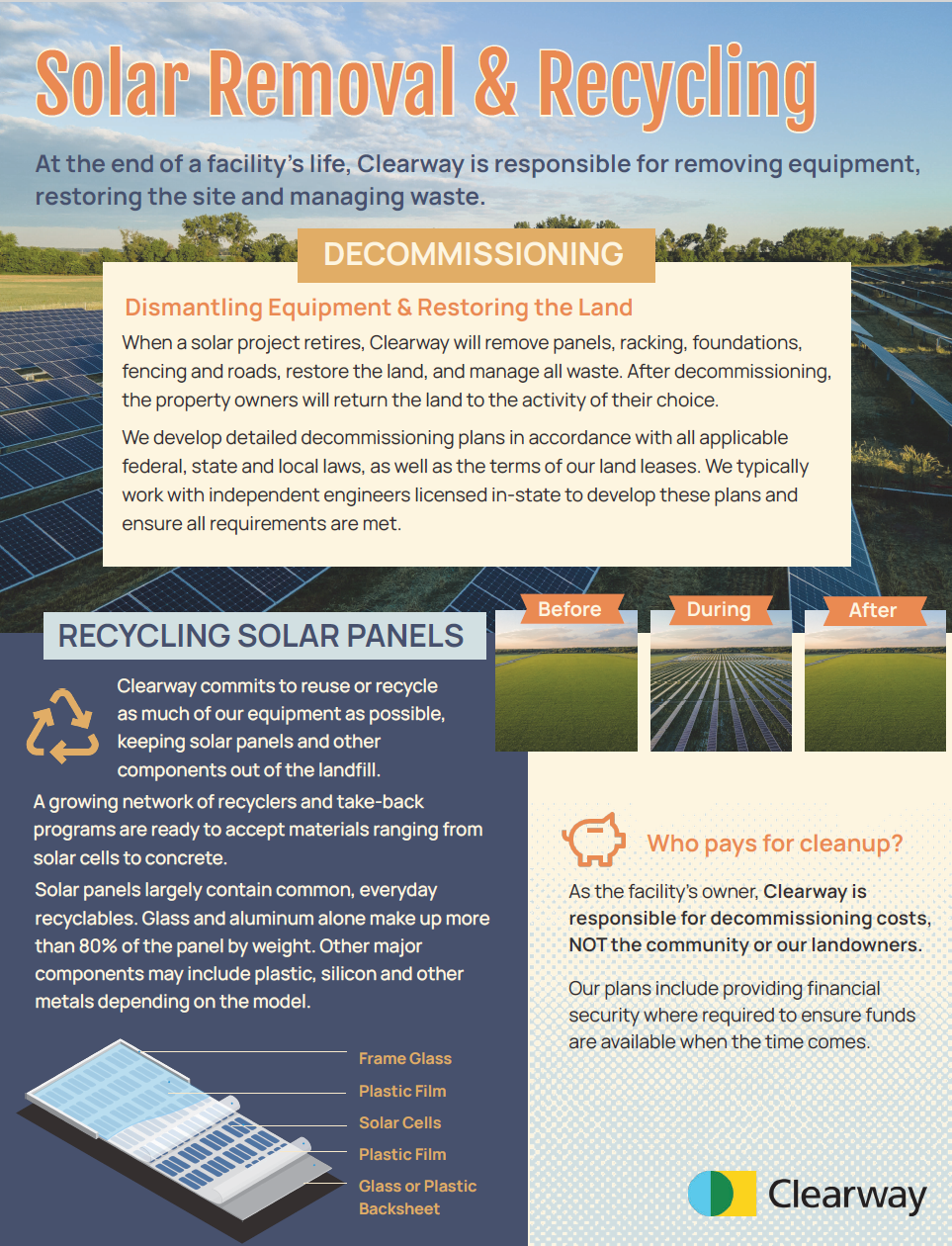
Clearway, as the long-term owner, is responsible for removing all equipment and restoring the site to its prior condition at the end of the project's operating life — not the community. Per Navajo County's requirements, Clearway will post a security bond backed by a regulated financial institution to guarantee funding for that work, which includes recycling solar panels and other materials, controlling dust and erosion, and replanting native vegetation.
Responsible waste management is an important part of Clearway’s environmental management program, supported by fast-growing solar and battery recycling industries in the United States.
The glass, aluminum, and silicon that make up most of a solar panel can all be recovered and reused. Clearway commits to recycling all solar panels used at Chimney Canyon Energy Center at the end of their life.
Clearway is also committed to identifying reputable battery recycling partners and including battery recycling in Chimney Canyon's decommissioning plan, with funds set aside in advance to ensure proper disposal.
Solar & storage learning resources
Learn more about utility-scale solar with the below resources from Clearway Energy and our partners.

_Page_1.jpg)
.jpg)
Get in Touch
The Clearway team wants to hear from you. Please fill out this form or email chimneycanyonsolar@clearwayenergy.com to get in touch.